
The Data Trap: Why Your Company Will Never Be “Data-Driven”
Or: How Developer Experience Became the Secret Weapon Nobody’s Talking About
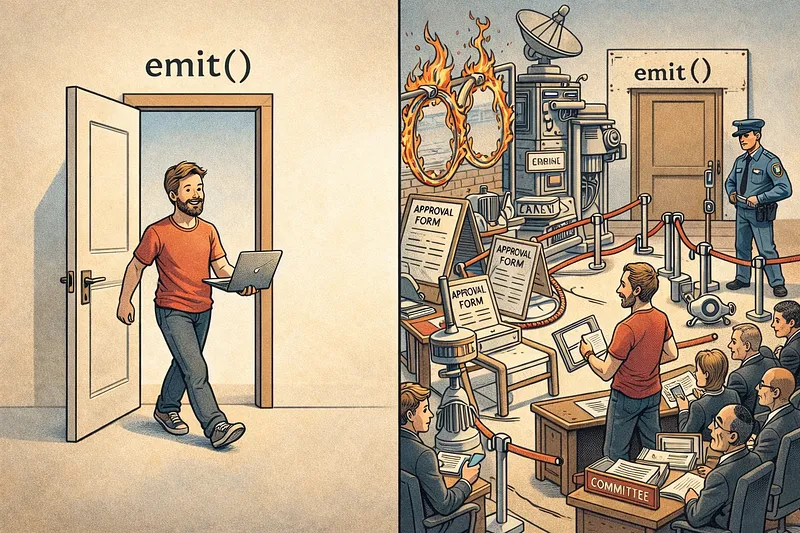
You’ve heard it in every all-hands meeting for the past five years. “We need to be more data-driven.” You’ve nodded along, maybe even clapped at the appropriate moments. Yet here you are, still making decisions based on the loudest voice in the room and whatever the most senior person had for breakfast. The dashboards exist. The data warehouse is running. So why does pulling a simple report still require a three-week ticket to the BI team?
Here’s the uncomfortable truth that nobody wants to admit: most companies don’t fail at becoming data-driven because they lack data infrastructure. They fail because they made data hard to work with. Every barrier you add between an engineer and their ability to emit a metric, every form they have to fill out to add a new table, every approval process for schema changes — you’re not building governance. You’re building a graveyard for good intentions.
As the economist John Kenneth Galbraith observed, “Faced with the choice between changing one’s mind and proving that there is no need to do so, almost everyone gets busy on the proof.” We’ve built entire data organisations around proving we’re data-driven rather than actually using data. We’ve mistaken the existence of a data warehouse for the presence of data culture.
The secret to becoming genuinely data-driven isn’t hiring a massive data team or buying expensive platforms. It’s making data stupidly easy to work with from day one. Focus on developer experience, and adoption will follow naturally. Ignore it, and you’ll end up with a beautiful data platform that nobody uses.
Let me walk you through what this actually looks like at each stage of company growth — and where most organisations go catastrophically wrong.
Stage One: The Blessed Simplicity of Early Days
When you’re a founding team of five people huddled around a single table, your data needs are refreshingly simple. You need to know what users are doing and whether your servers are on fire. That’s about it.
The temptation here is to over-engineer. I’ve seen pre-seed startups with Kafka clusters and elaborate data lake architectures, burning through runway on infrastructure for problems they don’t have yet. This is the engineering equivalent of buying a warehouse before you have inventory to store.
PostgreSQL with large disks can act as your first analytical store. It’s not technically a data lake — that’s raw files on object storage — but at this stage, you don’t need the distinction. PostgreSQL as your single source of truth for both operations and analytics is perfectly valid. A $200–500 per month managed PostgreSQL instance isn’t paying for scale. You’re paying to not think about backups and patching at 3 AM while you’re still finding product-market fit.
For analytics, start with what’s free and immediate. Google Analytics captures the basics. Mixpanel or Amplitude free tiers give you better product analytics. The goal at this stage isn’t building dashboards — it’s understanding what users are doing.
But here’s where the DX principle first appears: telemetry. Most teams skip observability at this stage because it feels like overhead. “We’ll add monitoring later when we’re bigger.” This is precisely backwards. The time to get visibility into your systems is before you need it desperately.
The good news is that contactless telemetry has matured significantly. OpenTelemetry zero-code instrumentation means you can get visibility with literally zero code changes. Add a Java agent. Set some environment variables. Done. Your services are now emitting traces, metrics, and logs without a single line of instrumentation code.
For what it’s worth, Azure Application Insights remains the gold standard for developer experience in observability. Auto-instruments .NET, Java, Node, and Python with minimal configuration. Automatic dependency tracking for SQL and HTTP calls. Live metrics streams. Smart anomaly detection. It’s the rare Microsoft product that actually delights developers.
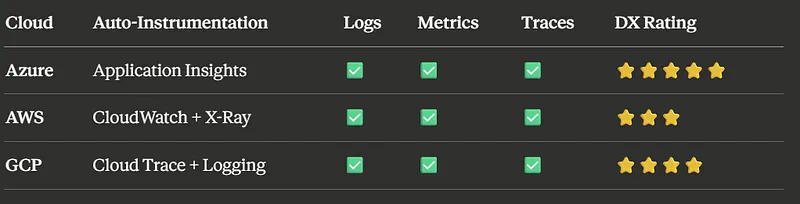
AWS has closed some gaps with CloudWatch Application Signals and the AWS Distro for OpenTelemetry, but it still requires more assembly — you’re wiring together CloudWatch Logs, CloudWatch Metrics, X-Ray for tracing, and Synthetics for availability monitoring. More pieces to assemble, but it works.
If you’re cloud-agnostic or want to avoid vendor lock-in, invest in OpenTelemetry early. Here’s what zero-code instrumentation actually looks like, this tiny amount of code gives you an immense amount of telemetry, so why not start now?
Java — literally zero code changes:
Download the agent
curl -LO https://github.com/open-telemetry/opentelemetry-java-instrumentation/releases/latest/download/opentelemetry-javaagent.jar# Run with agent
java -javaagent:opentelemetry-javaagent.jar
-Dotel.service.name=my-service
-Dotel.exporter.otlp.endpoint=http://otel-collector:4317
-jar myapp.jarPython — minimal setup:
pip install opentelemetry-distro opentelemetry-exporter-otlp
opentelemetry-bootstrap -a installopentelemetry-instrument
--service_name my-python-service
--exporter_otlp_endpoint http://otel-collector:4317
python myapp.py**.NET — environment variables and done:**
// In Program.cs — that's the entire instrumentation setup builder.Services.AddOpenTelemetry() .WithTracing(tracing => tracing .AddAspNetCoreInstrumentation() .AddHttpClientInstrumentation() .AddSqlClientInstrumentation() .AddOtlpExporter(opts => opts.Endpoint = new Uri("http://otel-collector:4317")));The point isn’t which cloud you’re on. The point is that observability with good DX is a solved problem. If your engineers are still manually adding logging statements and hoping for the best, you’re choosing to fly blind.
The coaching legend John Wooden once said, “If you don’t have time to do it right, when will you have time to do it over?” The same applies to data foundations. What you set up in the first few months creates patterns that persist for years. Make them good patterns.
Stage Two: The Critical Inflection Point
Somewhere between ten and fifty employees, you’ll hit what I call the data inflection point. This is when the CEO stops being able to hold the entire business in their head, when decisions start requiring actual numbers rather than gut feel, and when you desperately need someone who can make data accessible.
This is when you hire your first data person. But here’s the critical mistake most companies make: they hire a BI Engineer and immediately bury them in dashboard requests.
Your first data person’s job is NOT to build dashboards. It’s to make data accessible to everyone else. They should be evangelising self-service, not becoming a bottleneck. The moment your data person becomes the single point of failure for every data question, you’ve already lost.
The key insight at this stage is that data ingestion — getting data from where it lives into where you can analyse it — is the DX inflection point. If adding data is hard, people won’t do it. If it requires writing a three-page spec, waiting for a review cycle, and deploying to a production OLAP thing, your engineers will do what engineers always do when faced with friction: they’ll work around it. They’ll log to files. They’ll store things in local databases. They’ll build shadow analytics that nobody else can access.
At this stage, simple batch ETL is perfectly fine. Python scripts with cron jobs. Basic pipelines. The sophistication of your tooling matters far less than the friction of using it. I’ve seen teams with Airflow clusters and elaborate DAGs that took three days to onboard a new data source, while other teams with nothing but Python scripts and dbt could add a new pipeline in an hour. Guess which teams actually had data?
Speaking of dbt — if you’re not using it yet, you should be. It’s a transformation framework that lets you write SQL and treats your transformations as version-controlled, testable code. But note: dbt assumes data is already in your warehouse. It’s the T in ELT, not the E or the L. Pair it with something like Airbyte for ingestion and you’ve got a remarkably powerful stack with minimal ceremony.
This is also when you should introduce object storage — S3, Google Cloud Storage, Azure Blob, or MinIO if you’re self-hosting. The pattern is simple: land everything raw first, then ETL into your analytical store. When your ETL breaks (it will), you can replay from source. Object stores are cheap insurance. Never mutate raw data — treat it as append-only. Use partitioning conventions for queryability. Raw data is your audit trail and replay source.
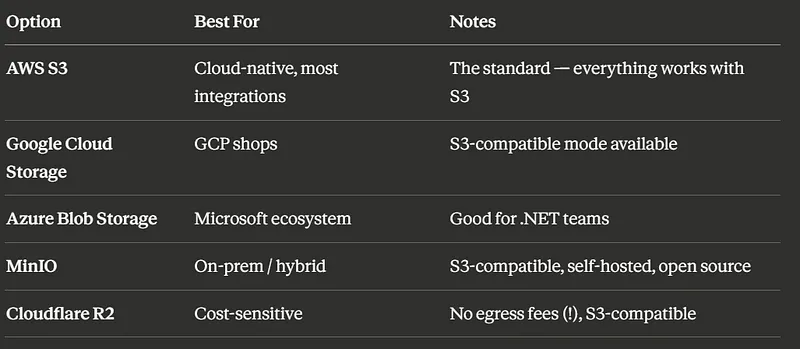
MinIO deserves special mention. If you’re concerned about cloud costs — and you should be, as we’ll discuss later — MinIO gives you S3-compatible object storage on your own hardware. Same APIs, your infrastructure. It’s particularly valuable for hybrid deployments where you want baseline storage on-prem with burst capacity to cloud.
If you want managed ETL without self-hosting Airbyte, the cloud providers have options:
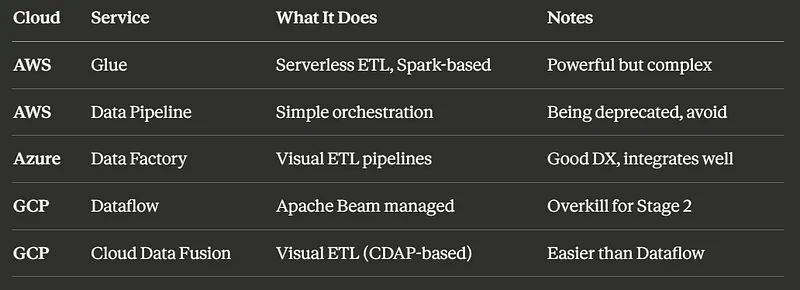
My recommendation at this stage: Airbyte (self-hosted or cloud) plus dbt is often simpler than cloud-native ETL services. Save Glue and Data Factory for later stages when you actually need their power.
The physicist Niels Bohr reportedly said, “An expert is a person who has made all the mistakes that can be made in a very narrow field.” At this stage, you’re building the foundations that will either enable or constrain you for years. Make the mistakes early, make them small, and make sure you can recover from them.
Stage Three: When Batch Becomes Stream
Around fifty to one hundred fifty employees, something interesting starts to happen. Some of your batch ETL jobs start feeling inadequate. Not all of them — many will remain batch forever, and that’s fine. Finance, billing, and compliance data often needs the auditability and accuracy that batch provides. But certain data streams start crying out for freshness.
This is when you evolve ETL to streaming — where it makes sense. Kafka, Pulsar, or managed alternatives like Confluent or AWS Kinesis. The key phrase is “where freshness creates value.” Don’t stream everything just because you can. Stream what needs to be fresh; batch what needs to be accurate.
Let me tell you about a pattern that worked remarkably well for us. Years ago, we built a developer experience layer on top of Kafka and Apache Camus — a now-deprecated tool that handled the Kafka-to-HDFS pipeline. The underlying technology was fairly standard. What made it special was the API we built for developers.
The architecture looked like this:
┌─────────────┐ ┌─────────────┐ ┌─────────┐ ┌───────┐ ┌──────────┐ │ C# Library │───▶│ JSON API │────▶│ Kafka │────▶│ Camus │───▶│ Hadoop │ │ .Send() │ │ + Schema │ │ Topics │ │ MR │ │ Tables │ └─────────────┘ └─────────────┘ └─────────┘ └───────┘ └──────────┘The principle was simple: your C# class properties become your Hadoop columns. Inherit from a base Message class, get all the plumbing for free. Class name determines topic and table name automatically. Table doesn’t exist? Created on first message. Table exists? Row added. No DDL scripts. No schema registry calls. No deployment ceremony.
Step 1: Define your message class
// Your class properties become columns in Hadoop public class UserSignupEvent : Message { public string UserId { get; set; } public string Email { get; set; } public DateTime SignupDate { get; set; } public string ReferralSource { get; set; } public bool IsEmailVerified { get; set; } }Step 2: Send data (that’s it)
// Create and send — the class name "UserSignupEvent" becomes the table name var signup = new UserSignupEvent { UserId = "usr_123456", Email = "[email protected]", SignupDate = DateTime.UtcNow, ReferralSource = "google_ads", IsEmailVerified = false }; signup.Send(); // Data flows to Hadoop. Done.Under the hood, the Message base class used reflection to handle everything:
// Inside the Message base class (simplified) public abstract class Message { public void Send() { // Reflection gets the class name → becomes topic/table name var typeName = this.GetType().Name; // "UserSignupEvent"
    // Serialize to JSON
    var json = JsonSerializer.Serialize(this);

    // POST to the ingestion API with schema info
    _apiClient.Post("/ingest", new
    {
        Type = typeName,
        Schema = GetSchemaFromProperties(),  // Reflection on properties
        Payload = json
    });
}

private object GetSchemaFromProperties()
{
    return this.GetType()
        .GetProperties()
        .Select(p => new {
            Name = p.Name,
            Type = MapToHadoopType(p.PropertyType)
        });
}
}Compare the developer experience:
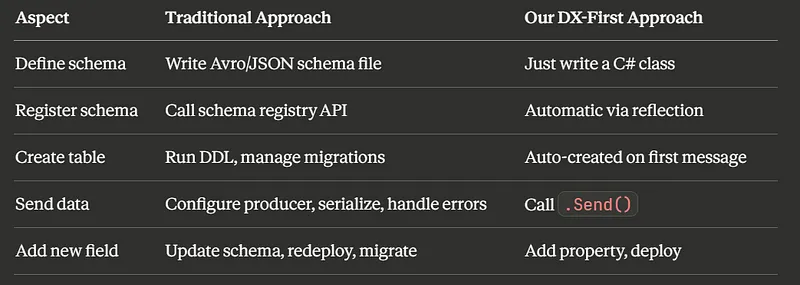
We didn’t invent new technology. We wrapped existing tools with a developer experience that made the right thing the easy thing. Any developer could add a new data stream in under five minutes. Compare that to organisations where adding a new event type requires a schema review, a registry update, a deployment, and a prayer.
Camus was eventually deprecated — batch latency meant data landed hourly rather than real-time, and it was too tightly coupled to Hadoop. Kafka Connect replaced it with streaming-first architecture and pluggable sinks. But the DX principles remain valid. The technology changes; the importance of making things easy doesn’t.
This is also when you need to start having uncomfortable conversations about cloud economics. When we were getting started on cloud platforms, they were in growth mode — aggressive pricing, generous free tiers, subsidised everything. Now they’re in profit mode. The cloud isn’t cheap anymore, and at certain scales, it’s actively expensive.
You’ve probably heard about DHH and 37signals leaving AWS, saving an estimated $7 million over five years by moving to owned hardware. Dropbox did something similar earlier, building their own storage infrastructure and saving $75 million over two years. These are extreme examples, but they point to a real phenomenon: at scale, with predictable workloads and capable infrastructure teams, on-premises or hybrid deployments can be thirty to fifty percent cheaper.
Most companies aren’t 37signals. Cloud exit requires significant ops maturity. But hybrid — baseline on-prem, burst to cloud — is increasingly realistic. The point isn’t that cloud is bad. The point is that you should actually do the math rather than assuming cloud is always the answer.
Stage Four: Platform as Product
Between one hundred fifty and five hundred employees, the nature of your data challenge fundamentally changes. You have enough data streams that discovery becomes a problem. You have enough teams that governance becomes necessary. You have enough complexity that nobody can hold the whole picture in their head anymore.
This is when you need a Data Marketplace or Data Catalog. Tools like Atlan, DataHub, or Alation. The goal is simple: anyone can find and trust data. But the implementation is anything but. A catalog that nobody updates is worse than no catalog at all — it gives people false confidence in stale information.
More fundamentally, this is when your data engineers need to shift from “doing the work” to “enabling others.” You’re building a platform now, whether you recognise it or not. And platforms have a different set of success criteria than projects.
The folks at ThoughtWorks and the Team Topologies crew have thought deeply about what makes platforms compelling. The key insight is that platforms should be opt-in, not mandated. They must provide clear value immediately. They should reduce cognitive load, not add to it. Self-service beats tickets every time. Documentation is product.
Matthew Skelton and Manuel Pais put it beautifully: “The purpose of a platform team is to enable stream-aligned teams to deliver work with substantial autonomy. The platform team’s job is to make things as simple as possible for internal customers.”
The best internal platforms are the ones developers choose to use, not the ones they’re forced to use. If your data platform requires a training course and a certification to use, you’ve failed. If it requires reading documentation longer than a few pages, you’ve failed. If the first-time experience doesn’t deliver value within minutes, you’ve failed.
The Experimentation Unlock
This is also when A/B testing becomes genuinely valuable. At earlier stages, you often don’t have enough traffic to run meaningful experiments. Now you do. Options abound — GrowthBook is open source with great DX and warehouse integration; LaunchDarkly combines feature flags with experiments (though it gets expensive at scale); Statsig has a generous free tier.
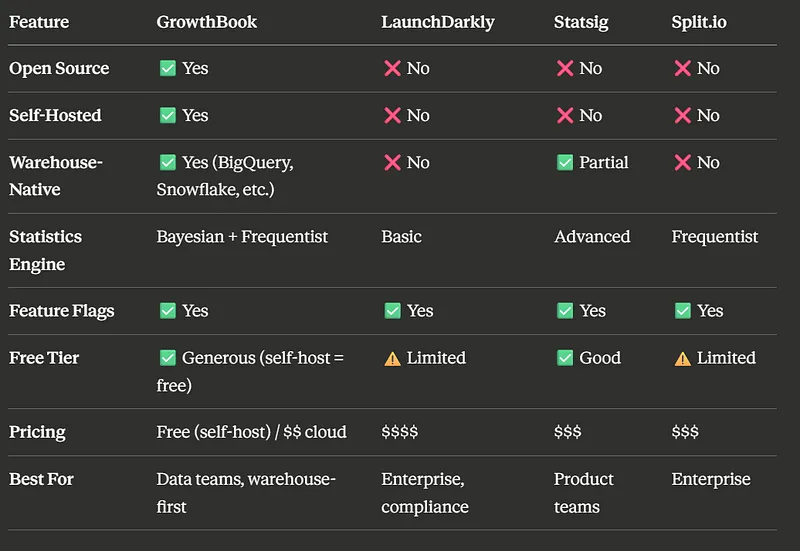
GrowthBook is particularly interesting because it pulls experiment data from your existing data warehouse. No separate event tracking infrastructure needed. Open source means full control and no vendor lock-in. Statistical rigor without needing a stats PhD.
But here’s the thing about A/B testing that people often miss: it only works if you already have good data. Experimentation is a late-stage capability that depends on early-stage foundations. If you didn’t invest in data quality and accessibility at stages one through three, your experiments at stage four will be meaningless. You can’t A/B test your way out of bad data.
The DX Principles That Never Change
Across all these stages, certain principles remain constant. They’re the difference between data platforms that get used and data platforms that become expensive monuments to good intentions.
Minimal boilerplate. One line to emit a metric. Auto-discovery of schemas. Convention over configuration. Every line of code a developer has to write, every configuration file they have to manage, every approval they have to seek — you’re reducing adoption.
Immediate feedback. Can developers see their data in less than five minutes? Is there a local development story? Do preview environments exist? The gap between “I wrote the code” and “I can see it working” is the gap between adoption and abandonment.
Clear errors. Not “schema mismatch” — tell me which field. Validation before ingestion, not after. Dry-run modes that catch problems before they hit production.
Progressive disclosure. Simple things simple, complex things possible. Sensible defaults that just work. Advanced options available but not required. Not everyone needs the full power of your platform. Most people need the simple path.
Here’s what bad DX looks like in practice:
from data_platform import DataProducer, SchemaRegistry, Config config = Config.load("config/data-platform.yaml") registry = SchemaRegistry(config.registry_url, auth=config.auth) schema = registry.get_schema("events.user_action.v3") producer = DataProducer(config, schema, validate=True) producer.connect() try: producer.emit({"user_id": "123", "action": "click"}) finally: producer.close()And here’s what good DX looks like:
from data_platform import emit emit("user_action", {"user_id": "123", "action": "click"})Both examples do the same thing. One will get used. One won’t. I’ll leave you to guess which.
The Bottom Line
As the architect Christopher Alexander observed, “When you build a thing you cannot merely build that thing in isolation, but must repair the world around it, and within it, so that the larger world at that one place becomes more coherent.” We’ve been doing the opposite with data infrastructure — building things that make the world around them less coherent, one policy at a time.
The companies that actually become data-driven aren’t the ones with the most sophisticated platforms. They’re the ones that made data stupidly easy to work with. They invested in developer experience at every stage. They understood that every barrier to adding data reduces the chance someone will add it. They treated their data platform as a product with users, not a project with a deadline.
Start collecting data on day one. Your first analytical store can be PostgreSQL — don’t over-engineer. Hire one data person early and make sure their job is enabling others, not becoming a bottleneck. DX is the multiplier — every friction point reduces adoption. Cloud isn’t always cheaper — do the math as you scale. ETL is a stepping stone to streams, not a failure mode. A/B testing requires data maturity — it’s a later-stage capability.
The best time to start building good data foundations was when your company started. The second best time is now.
Now, if you’ll excuse me, I need to go simplify an API that currently requires twelve lines of boilerplate to emit a single event. Apparently, we’re “committed to developer experience.” The irony writes itself.