
The 1:1 Is Broken (And You’re Both to Blame)
Or: Why the Most Important 30 Minutes of Your Week Has Become the Least Honest
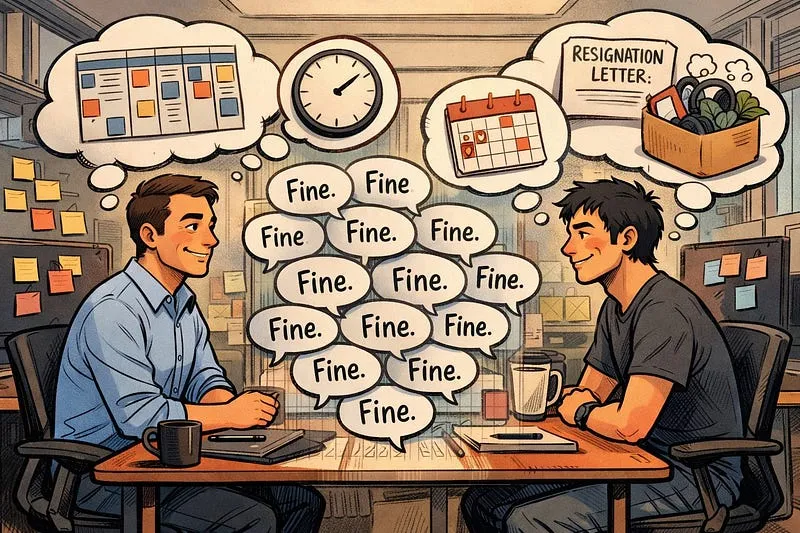
It was 2:15 on a Tuesday. The air conditioning in the meeting room was losing its war against the Bangkok afternoon, and the faint sweetness of someone’s iced coffee — long since abandoned on the table outside — drifted in every time the door sealed shut. My third 1:1 of the day. Kumar settled into the chair across from me, laptop half-open, the blue glow of Slack notifications pulsing silently against his chin. He’d been instrumental lately — the kind of engineer who made everything around him better without needing to be asked, the kind you build plans around. I asked the question I always ask. “How are you going?” He shifted his weight, eyes briefly finding the corner of the room before coming back to me. “I’m fine.” The word landed flat, like a coin dropped on carpet. I heard it. I noted it. And I moved on to the project updates, because that’s what we do.
The flatness stayed for weeks. Same posture, same half-smile, same “fine” delivered with slightly less conviction each time. I told myself it was just a phase — maybe a rough patch at home, maybe fatigue. I didn’t push. He said he was fine.
Then came the meeting I’ll never forget. I’d prepared the promotion announcement. Had the budget sign-off, the new title, the whole thing ready to go. I could feel the warmth of it — the good news, the recognition he’d earned. I told him. And the look on his face wasn’t what I expected. It was guilt. The kind that sits behind someone’s eyes when they know something you don’t. He told me he’d accepted another offer. The sweetness of the promotion curdled in the silence between us. I sat there, the hum of the air conditioning suddenly deafening, holding a title for a person who was already gone.
I learnt a hard lesson that afternoon. But it’s those lessons that sear into you — the same way a production incident at 3 AM burns into your memory and makes you quietly check if your LinkedIn profile is up to date before you’ve even finished the post-mortem. You don’t forget them. They don’t let you.
Peter Drucker once observed, “The most important thing in communication is hearing what isn’t said.” That sentence should be framed above every manager’s desk, because it describes exactly what broke in that meeting room. “Fine” wasn’t a status update. It was a closed door. And I stood outside it for weeks, accepting the deadbolt as an answer, because what was behind it might have been uncomfortable. More uncomfortable than a resignation, though? Not a chance.
Let’s talk about why the one meeting designed to surface problems is the last place they actually appear.
The Status Report Disease
You know the pattern. The engineer shows up with an accomplishment list like they’re defending a thesis. The manager nods through it. Fifteen minutes pass. Someone checks the time. The whole thing could have been a Slack message — and everyone in the room knows it.
This is the same disease that plagues standups everywhere. The meeting exists on the calendar, so both parties show up and go through the motions. Nobody asks why they’re actually there instead of just posting an async update. The ritual replaces the purpose.
But unlike a standup, the 1:1 isn’t about the work. It’s about the person. And when you fill it with Jira ticket readouts, you’re not just wasting time — you’re actively blocking the conversation that matters.
“Fine” as a Treaty
Here’s the dynamic nobody admits to: both sides have silently negotiated a deal. I won’t ask hard questions if you don’t bring me hard problems.
The manager doesn’t want to hear something they can’t fix, or worse, something that requires a difficult conversation with their own boss. The engineer doesn’t trust that honesty won’t be held against them — in performance reviews, in project assignments, in how they’re talked about in calibration. So “fine” becomes the answer. Not because things are fine, but because “fine” is the safest word in the English language.
The comfort of your 1:1 is inversely proportional to its value. If every session feels pleasant and surface-level, you’re not having a 1:1. You’re having a mutual non-aggression pact.
The Surveillance Trap
The opposite failure mode is equally destructive. The manager who asks “walk me through each step you took to set up the API endpoints” or “what did you do in the three hours after lunch?” They don’t see it as surveillance — they genuinely think they’re “just trying to understand where we are on the project.”
But the engineer starts spending more time thinking about how to explain what they did than actually doing the work. That’s the tax. When the 1:1 becomes an accountability check, the engineer optimises for looking productive rather than being productive. You’ve replaced trust with theatre, and you’re both worse off for it.
You can’t build trust through interrogation. You build it by making people feel safe enough to tell you where they’re struggling.
The Emotional Labour Tax
Nobody talks about this part, but it’s happening in every 1:1 you’ve ever had. Engineers don’t just show up — they prepare a performance. They curate their update to sound competent but not arrogant, busy but not overwhelmed, independent but not disconnected. Managers perform too: they ask “how are you doing?” with a tone that suggests they care, but with body language that says they have twelve minutes before their next meeting.
Both sides are acting. The meeting becomes theatre. And the real conversations — the ones about frustration, about feeling stuck, about the colleague who isn’t pulling their weight, about the creeping suspicion that this role isn’t what they signed up for — those happen in private Slack DMs, over beers after work, in resignation letters. Everywhere except the one meeting designed to catch them.
Where Problems Actually Surface
I’ve had managers tell me everything is fine with their teams, only to discover through skip-levels and engagement surveys that it absolutely wasn’t. Is that the manager’s fault? They asked in the 1:1. The engineer said “fine.” Why dig more?
Because “fine” is a lie you’re both telling. And I’ve lost good engineers because I didn’t push past it. Because I accepted the surface answer and moved on to project updates and sprint velocity.
If problems are surfacing in engagement surveys, skip-levels, exit interviews, Glassdoor reviews, or just quietly in attrition numbers — everywhere except your 1:1s — then your 1:1s are broken. The feedback mechanism you need already exists. It’s the 1:1. It’s just not functioning.
The Engineer’s Side: Your 30 Minutes of Leverage
Here’s a mindset shift that changes everything: stop seeing your manager as the authority figure who assigns work. Start seeing them as a resource with context you don’t have.
Your manager knows things about org priorities, budget decisions, headcount plans, how leadership perceives your team, what’s coming next quarter — context that directly affects your career and your work. You’re sitting across from someone who has information you need and thirty minutes of dedicated time. Using that time to read out your Jira tickets is, frankly, insane.
This is the person who decides your projects, your visibility, your promotion timing. They write your review. They represent you in calibration. They choose which opportunities come your way. Every other meeting you attend is about the work. This one is about you. Treat it accordingly.
Preparation Is the Unlock
Ten minutes of prep before the meeting transforms it. Three questions: What’s my hardest problem this week? What feedback do I need? What’s unclear about my growth? Write it down. Send it twenty-four hours early. This forces you to think about what actually matters instead of defaulting to status updates, and it gives your manager time to think instead of reacting on the spot. Most managers will give you dramatically better answers when they’ve had time to consider the question.
Make It Awkward on Purpose
The best 1:1s are uncomfortable. You’re talking about weaknesses, concerns, ambitions, fears about your career trajectory, disagreements with decisions. If every 1:1 feels comfortable, that’s a signal you’re wasting it. The discomfort is where the growth lives.
Stop Waiting for Permission
Your manager isn’t testing you by staying silent. They’re not withholding the magic question that will unlock the conversation. They’re waiting for you to take ownership. Most managers have been trained to “let the report drive the 1:1” and are sitting there hoping you’ll bring something real. When you don’t, they default to “so how’s the sprint going?” because they don’t know what else to do.
Close the Loops
If your manager commits to something — looking into a role change, raising something with their boss, getting you on a project — write it down. Follow up next time. This isn’t about catching them out. It’s about building a pattern where both sides take the meeting seriously. Nothing kills 1:1 trust faster than a manager who agrees to things and never follows through. But nothing builds it faster than an engineer who tracks commitments and closes them.
The Manager’s Side: Creating the Conditions
You can’t demand honesty you haven’t earned.
You can’t ask “how are you really doing?” if the last person who answered honestly got labelled as negative, or had their concern dismissed, or watched it get brought up in a team meeting without their consent. Trust is built in small moments — how you react when someone pushes back in a code review, whether you actually do something with feedback, whether you share context about decisions or just announce outcomes. The 1:1 doesn’t exist in isolation. It inherits the trust level of every other interaction you’ve had with that person.
Stop Accepting “Fine”
Not by interrogating — that’s the surveillance trap we just talked about. By going first. Share something you’re struggling with. Admit a decision you’re unsure about. Talk about feedback you received that stung. Model the vulnerability you’re asking for. If you’ve never been uncomfortable in your own 1:1 with your report, you’ve never actually shown up to it.
Instead of just asking “How are you going?” — think deeper. How is the team going? How is the work — are they enjoying it? If you haven’t yet built the psychological safety you’re aiming for (and this takes time, don’t blame yourself if you’re not there yet), look for the tells. Your engineers aren’t poker-face experts. They’ll give it away. Once you hit a question with a specific note — “How’s Somchai doing? Is he doing good work?” — if you see an immediate change in facial expression or tone, that’s it. That’s the topic to dig into. But do it softly. Don’t be accusatory and ask “So what’s wrong with Somchai?” Instead, ask gently: “Has he been contributing well lately?” Don’t throw accusations. Open doors.
The Score Out of Ten
A manager I know has replaced the “How are you going?” opener entirely. He starts with: “Give me a score out of ten for how you think you’re performing right now.” Ten being the most amazing engineer in the company, one being the worst. Then he gives his own score for them, and they reveal at the same time. It’s a brilliant conversation starter — it immediately creates something concrete to discuss rather than trading pleasantries. And as a side effect, come performance review time, the two of them are generally far more aligned because they’ve been calibrating against each other all year.
Coaching vs. Checking
A status check asks “what did you do?” A coaching conversation asks “what are you learning?” or “what would you do differently?” or “what’s the thing you’re avoiding?” The first one generates a list. The second generates growth. Most managers default to checking because coaching requires them to actually know their people, have opinions about their development, and be willing to say hard things.
The Dual Perspective Problem
Here’s why this topic hits different for engineering leaders: you’re on both sides of the table. You’re simultaneously running 1:1s with your reports and having 1:1s with your own manager. You know what it feels like to sit across from someone who gives you nothing. And if you’re honest, you know what it feels like to be the one giving nothing.
Most advice about 1:1s targets one audience — either “managers, here’s how to run better 1:1s” or “engineers, here’s how to get more from yours.” But if you’re reading this, you’re probably both. You’re the manager accepting “fine” at 2 PM and the engineer performing “fine” at 3 PM. Recognising that dual role is the first step toward fixing it on both sides.
As Maya Angelou wrote, “There is no greater agony than bearing an untold story inside you.” That’s your engineer sitting across from you, performing “fine” for thirty minutes while the real story stays locked behind their teeth. And that’s you too, pretending the surface answer was enough because the truth might require something you’re not ready to give.
The Bottom Line
The 1:1 isn’t broken because people don’t care. It’s broken because both sides have optimised for comfort over honesty, for safety over growth, for the appearance of communication over its substance. The manager accepts “fine” because pushing further is uncomfortable. The engineer offers “fine” because honesty feels risky. And between them, the gap widens until it shows up as a resignation letter on an otherwise average Tuesday.
Fix starts with both sides. Engineers: own your thirty minutes. Prepare. Bring the uncomfortable stuff. Stop performing and start asking for what you need. Managers: earn the honesty. Go first with vulnerability. Stop accepting surface answers. Watch for the tells. And when someone says “fine” with flat eyes and a distracted tone, don’t let the calendar invite end the conversation for you.
The 1:1 is the feedback mechanism. It’s the early warning system. It’s the one meeting that exists entirely for the human being sitting across from you. If it’s not working, everything downstream from it — retention, performance, trust, team health — is running on luck.
Now, if you’ll excuse me, I have my next 1:1 in ten minutes. I should probably prepare for it properly for once — I hear the advice is excellent, even if the person giving it should have followed it sooner.